
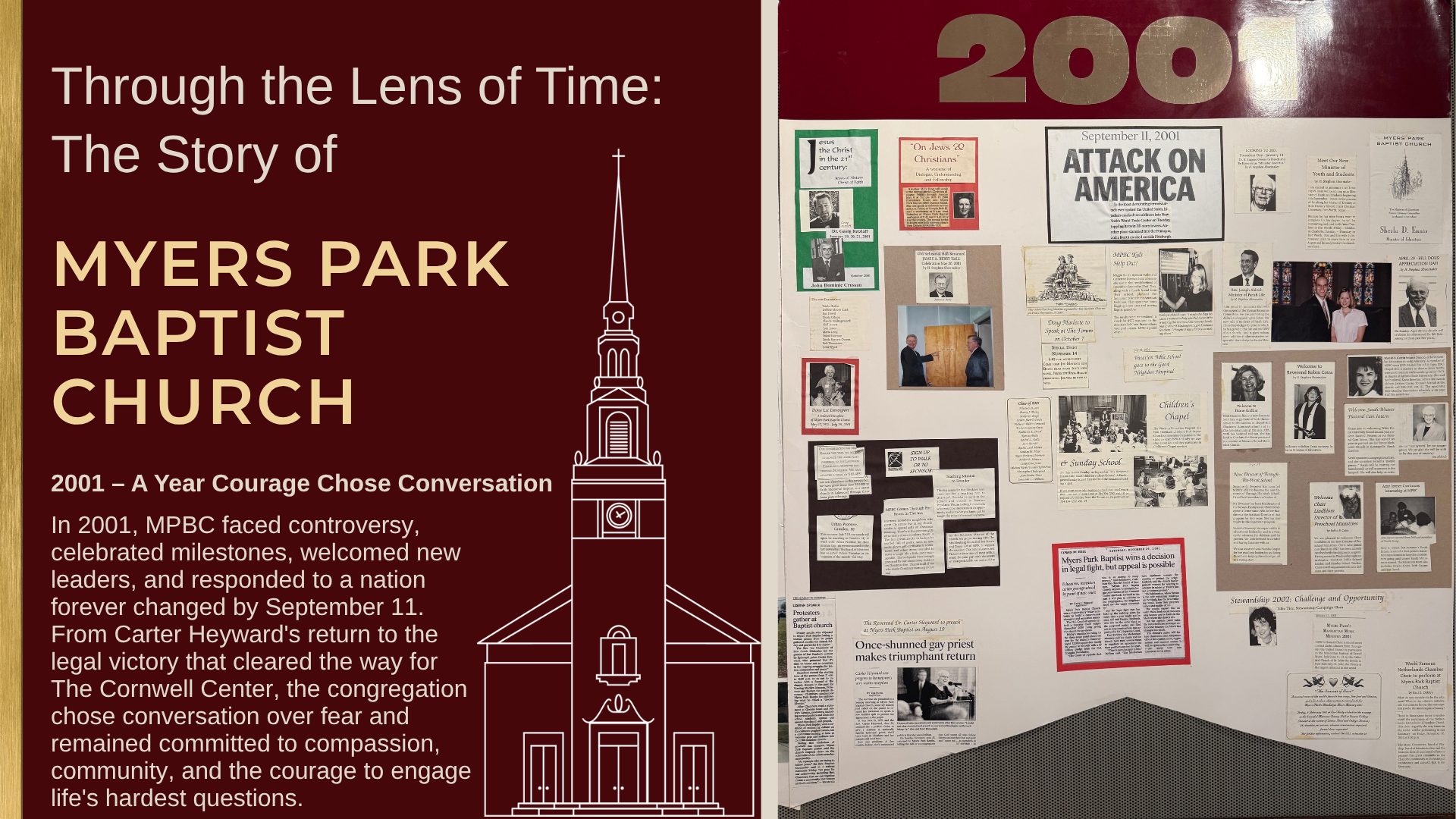
2001 - A Year Courage Chose Conversation
Some years are remembered for a single defining event. Others are remembered for the many questions they force a community to ask. In 2001, Myers Park Baptist Church navigated a year marked by public controversy, national tragedy, growing ministries, and bold visions for the future. Through moments of tension and hope alike, the congregation continued to live out its conviction that faith is not strengthened by avoiding difficult conversations, but by engaging them with courage, compassion, and grace.
A Church Willing to Ask Hard Questions
In 2001, Myers Park Baptist Church found itself at the center of a conversation unfolding across churches throughout America.
In February, twenty protesters gathered outside the church to object to the congregation's decision to welcome Episcopal priest Rev. Carter Heyward to the pulpit. Led by Rev. Joe Chambers of Paw Creek Ministries, the protest criticized both Heyward's ministry and Myers Park Baptist's ongoing efforts to explore how the church could more fully welcome gay and lesbian individuals into congregational life.
The gathering attracted local pastors, Christian school students, and members of the community. Yet even amid disagreement, church leaders sought a different path.
Senior Minister Rev. Dr. H. Stephen Shoemaker responded with grace, acknowledging that Christians of goodwill could disagree while expressing the church's hope for a community that honored all God's children. His words reflected a tradition long established at Myers Park Baptist: engaging difficult issues not with fear, but through thoughtful dialogue and faithful discernment.
A Homecoming Decades in the Making
The controversy surrounding Carter Heyward's visit carried a deeper story.
More than twenty years earlier, on November 19, 1979, Heyward had preached at Myers Park Baptist shortly after publicly announcing that she was a lesbian. At that time, her appearance generated significant opposition. Some church leaders urged that the invitation be withdrawn, and several families left the church in protest.
Her return in 2001 painted a very different picture.
Now an internationally recognized theologian and Episcopal priest, Heyward preached to approximately 650 worshippers, encouraging them to cast aside fear and guilt and to "come out as ourselves in the ongoing struggles for justice, compassion, and peace."
Following worship, she participated in a Sermon TalkBack session, answering questions and sharing openly about her journey. Reflecting on her own experience, she remarked, "I could not stay closeted and preach as a priest or theologian with much integrity."
The contrast between her 1979 visit and her 2001 return illustrated not only changes within society but also the growing commitment of Myers Park Baptist to honest dialogue, inclusion, and theological exploration.
Creating Space For Community
While conversations about faith and inclusion captured public attention, another long-running challenge was finally nearing resolution.
For years, Myers Park Baptist had pursued plans to build a new education and recreation facility that would expand the church's ministry capacity. The proposed 32,000-square-foot center faced significant legal challenges from neighboring residents Bill and Pauline Medearis, who argued that historic deed restrictions prohibited such development.
On December 28, 2001, the North Carolina Court of Appeals unanimously upheld a previous Superior Court ruling in favor of the church.
The decision cleared the way for construction of what would become The Cornwell Center, supported by a $7 million pledge from the C.D. Spangler Foundation.
Deacon chairman Ed Hinson described the ruling as "an answer to many prayers." The facility would ultimately include classrooms, computer resources, parish nurse offices, a gymnasium, exercise spaces, and areas designed to serve both the congregation and the broader community.
Although the legal battle highlighted tensions between neighborhood concerns and congregational vision, the ruling marked an important step forward in Myers Park Baptist's expanding ministry.
Building Bridges Across Faith Traditions
The church's commitment to meaningful conversation extended beyond its own walls.
In May, Myers Park Baptist partnered with Temple Beth El for its annual Jewish-Christian Dialogue, a weekend dedicated to understanding, fellowship, and interfaith learning. Featured speaker Mary Boys, a respected scholar in Jewish-Christian relations, led workshops and discussions designed to foster deeper relationships between faith communities.
The event reflected Myers Park Baptist's longstanding belief that dialogue enriches understanding and that faithful engagement often begins by listening well to those whose experiences differ from our own.
Music That Reached Beyond Charlotte
The arts continued to play a significant role in congregational life throughout 2001.
The church hosted the internationally acclaimed Netherlands Kamerkoor (Chamber Choir), considered among the world's finest vocal ensembles. The performance brought musicians and audiences together in the sanctuary's renowned acoustical setting and underscored the church's commitment to excellence in sacred music.
Meanwhile, Myers Park Baptist's own Chancel Choir received national recognition by being selected as one of only seven choirs in the United States invited to participate in the Manhattan Festival of Sacred Music at the Cathedral Church of St. John the Divine in New York City.
To support the trip, members organized The Seasons of Love, an elegant evening of music, food, fellowship, and fundraising that highlighted the congregation's creativity and enthusiasm.
September 11 and a Community's Response
Everything changed on September 11, 2001.
Like people across the nation, the congregation watched in horror as terrorist attacks struck New York, Washington, D.C., and Pennsylvania. The tragedy brought grief, uncertainty, and fear into homes, schools, churches, and communities across America.
Yet even in the face of heartbreak, members of Myers Park Baptist looked for ways to respond.
Young church members Maggie Butler, Spencer Butler, Catherine Norman, and their friends organized a neighborhood lemonade stand to support the American Red Cross. Through two hours of determined work, flag waving, and fundraising, the children raised an extraordinary $572 for relief efforts. Another young member, Kathryn Aldrich, made flags to support those affected by the attacks and collected donations for the Red Cross.
Their efforts served as a reminder that compassion has no age requirement. In a season marked by national sorrow, these children demonstrated that even small acts of kindness can carry profound meaning.
Investing in the Next Generation
Through Children's Chapel and Sunday School, led by Rev. Sharon Doar, Myers Park Baptist helped its youngest members learn not only the practices of worship but also the meaning behind them. The Worship Education Program served as a vital extension of the church's educational ministry, creating opportunities for children to grow in faith through participation and discovery.
Church publications from the year highlighted the joyful presence of children gathered in Children's Chapel and Sunday School classrooms, where lessons, friendships, and spiritual foundations were taking root each week.
Among the children actively participating in these ministries were Allison E. Austin, Brooks J. Bailey, George G. Brugh, Robert Sherrill Cordle, Melissa Walden Cornwell, Walter Emerson Davis, Kathrine E. Dowd, Ramsey Dulin, Rachel L. Hollis, Sara Kneidel, Rachel Lea Martin, Lindsey M. Miller, Ryan Frederick Morrison, Jordan B. Schwarz, Cecily Erin Steele, Michael Keith Trandel-Korenchuk, Christopher Underwood, Sean Paulus Vann, and Jonathan L. Williams.
While the headlines of 2001 often focused on larger events and public debates, the church continued its quieter work of shaping the next generation. In classrooms, chapels, and hallways, seeds of faith were being planted that would bear fruit for years to come.
New Faces, New Energy
If 2001 revealed anything about Myers Park Baptist, it was that the church was preparing for the future. Across nearly every area of congregational life, new leaders stepped forward to guide ministries, strengthen relationships, and expand opportunities for growth and service.
As the church navigated change, welcomed new members, and expanded its outreach, a remarkable group of ministers and staff members joined the work already underway. Their arrivals reflected both the vitality of the congregation and its commitment to investing in the people who would help shape its next chapter.
Among those welcomed or recognized in new roles were:
Joe Aldrich, promoted to Minister of Parish Life
Timothy W. Dean, called as Minister of Youth and Students
Diane Griffin, Financial Secretary
Susanne G. Sweeney, Director of Through-The-Week School
Robin P. Coira, Interim Minister of Education
Sheila D. Ennis, Minister of Education
Cheri Lindblom, Director of Preschool Ministries
Mariah B. Currin, Director of New Member Ministries
Sarah G. Weaver, Pastoral Care Intern
The church also celebrated the continued ministry of Amy C. Joyner, who remained actively involved in youth leadership during a period of transition.
Together, these leaders reflected a congregation investing intentionally in education, pastoral care, membership development, and the spiritual growth of every age group.
Serving Beyond the Sanctuary
If there was a common thread running throughout 2001, it was service.
The church contributed more than $10,000 through loose plate offerings to support ministry in the Lakewood community. Members partnered with Loaves & Fishes, supported Urban Promise in Camden, New Jersey, participated in the Regional AIDS Interfaith Network, opened their doors through Room In The Inn, and continued preparations for educational mission work in Guayaquil, Ecuador.
Whether serving neighbors across Charlotte or partnering with communities around the world, Myers Park Baptist remained committed to putting faith into action.
Looking Back Through the Lens of Time
When viewed through the lens of time, 2001 was not a year that can be reduced to a single headline.
It was a year when Myers Park Baptist Church stood publicly for dialogue in the midst of disagreement. It was a year when old wounds and new possibilities met in the return of Carter Heyward to the same pulpit that had once sparked such controversy. It was a year when the church celebrated long-awaited victories, welcomed new leaders, nurtured children and youth, expanded its ministries, and responded to a nation in mourning with acts of compassion and service.
Most of all, 2001 revealed a congregation willing to live faithfully within tensions rather than flee from them. In a world increasingly defined by division, Myers Park Baptist continued choosing conversation over silence, community over fear, and hope over certainty. Looking back now, the story of 2001 is not simply about the events that happened. It is about a church discovering, again and again, the courage to become the community it believed God was calling it to be.