
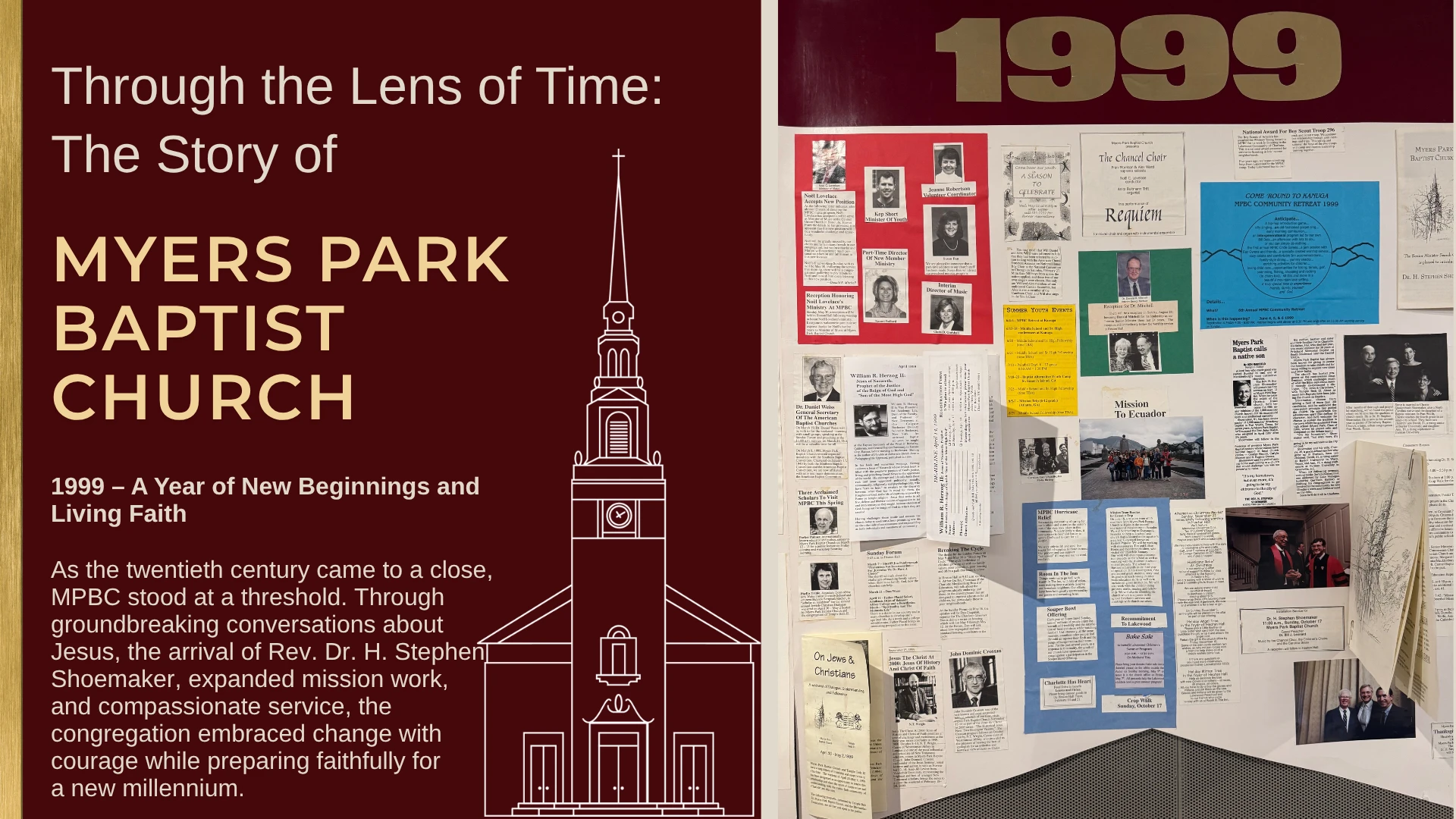
1999 - A Year of New Beginnings and Living Faith
As the twentieth century drew to a close, Myers Park Baptist Church found itself standing at a threshold. The approaching millennium invited both reflection and anticipation, prompting questions about faith, identity, and the future of the church. Throughout 1999, the congregation embraced that moment with characteristic curiosity and courage. Through the final chapter of its landmark Jesus the Christ at 2000 series, the calling of a new senior minister, expanding mission partnerships, and acts of compassion reaching far beyond Charlotte, Myers Park Baptist demonstrated that faith was not simply a matter of belief, but a way of living. It was a year of new beginnings, thoughtful exploration, and renewed commitment to following Christ into an unknown future.
Jesus the Christ at 2000: Looking Toward a New Millennium
The three-year Jesus the Christ at 2000 series entered its concluding year by welcoming several nationally and internationally respected scholars and teachers. Parker Palmer, an internationally known educator and author, was scheduled to visit March 12–13 for a public lecture and Saturday morning workshop. Phyllis Trible, Associate Dean of the new Wake Forest Divinity School and an eminent teacher and scholar of Hebrew Scripture, came to Myers Park Baptist for the second annual Jewish-Christian Dialogue weekend, held April 30–May 2 in partnership with Temple Beth El. N. T. Wright, Canon of Westminster Abbey in London and one of the most influential New Testament scholars of the period, came October 8–10.
John Dominic Crossan, co-founder of the Jesus Seminar, lecturer, and one of the best-known and most respected biblical scholars of the time, was scheduled to visit November 12–14. Amy-Jill Levine of Vanderbilt University, described as one of the brightest younger New Testament scholars, was scheduled to bring the series to a close
Myers Park Baptist sought to give Charlotte's wider community access to contemporary scholarship while encouraging an exchange of ideas and a deeper awareness of Jesus. The series invited participants to look beneath Christian creed and dogma toward the historical Jesus of Nazareth. Although the scholars approached Jesus differently, the program emphasized a shared discovery: Jesus was deeply concerned with human relationships, and with the political, economic, and social ways people treat one another. The hope was that serious study could connect theology directly to everyday life and lead toward "a living creed for the new millennium."
Welcoming Rev. Dr. H. Stephen Shoemaker
One of the most significant events of 1999 was the calling of Rev. Dr. H. Stephen Shoemaker as the church's fifth senior minister. Following a lengthy and prayerful search involving more than one hundred candidates, the congregation selected Shoemaker to lead Myers Park Baptist into its next chapter.
Shoemaker arrived from Broadway Baptist Church in Fort Worth, Texas, where he had served for seven years as senior pastor. Yet his call represented more than a professional transition. A Charlotte native and graduate of Myers Park High School, he described the opportunity as both a homecoming and a spiritual calling. The son of Hal Shoemaker, who had served for three decades as music minister at Pritchard Memorial Baptist Church, he understood the city's religious landscape and appreciated the distinctive character of Myers Park Baptist. Shoemaker had published four books, including one endorsed by Lake Wobegon humorist Garrison Keillor. He was also known for community involvement, running 15 miles a week, and playing the cello.
What attracted Shoemaker most was the congregation's reputation for intellectual openness, courageous leadership, and freedom of inquiry. He often spoke of the church as his "entrance to the city of God," recognizing a community willing to ask difficult questions and engage diverse perspectives. Joining him in the transition were his wife, Cherrie Quakenbush Shoemaker, and their children, David and Ann. His installation service was held in mid October with Dr. Bill J. Leonard as guest preacher. Music was provided by the Chancel Choir, the Children's Choirs, and the Carolina Brass, followed by a reception in Heaton Hall.
Honoring Dr. Donald Mitchell's Leadership
The arrival of a new pastor also marked the conclusion of an important transitional season. On August 29, the congregation gathered in Heaton Hall to honor Dr. Donald Mitchell for more than two years of faithful service as Interim Senior Minister.
Mitchell's leadership provided stability during a period of uncertainty and helped guide the church through the search process that ultimately brought Shoemaker to Myers Park Baptist. His ministry offered reassurance and continuity, preparing the congregation to embrace the opportunities ahead.
Celebrating the Ministry of Noël Lovelace
Change came in another area of church life as well. After nearly twelve years of leadership, Noël Lovelace accepted a call to become Minister of Music at Central Union Church in Honolulu, Hawaii.
Lovelace's departure represented a significant moment for Myers Park Baptist. Through choirs, worship services, and countless personal relationships, he had shaped the congregation's musical life and enriched its spiritual experience. While members celebrated this new opportunity for Noël and Marion, they also recognized the lasting impact his ministry had made on the church community.
A New Baptist Connection with Dr. Daniel Weiss
As Myers Park Baptist looked toward the future, it continued defining its place within the broader Baptist tradition. The congregation welcomed Dr. Daniel Weiss, General Secretary of the American Baptist Churches, for a weekend of conversation, teaching, and worship.
His visit carried particular significance following the church's 1998 decision to end its organizational ties with the Southern Baptist Convention. Chartered in 1943 by both the Southern Baptist Convention and the American Baptist Convention, Myers Park Baptist was continuing to shape an identity rooted in historic Baptist principles while remaining connected to a larger denominational family. Dr. Weiss's presence reflected the church's commitment to charting its own path while maintaining meaningful relationships with fellow Baptists.
Faith Made Visible Through Service
In the aftermath of devastating hurricanes that struck eastern North Carolina, Myers Park Baptist responded with compassion and practical action. Congregants collected and delivered five truckloads of supplies to communities facing overwhelming loss.
The effort demonstrated a defining characteristic of the congregation's faith: belief expressed through service. Members understood that prayer and compassion could not remain abstract when neighbors were suffering. The church's response became a powerful witness to its conviction that faith is most authentic when it is lived.
Serving Beyond Borders
The congregation's commitment to mission was also evident in its growing international partnerships. In June, a fifteen-member mission team traveled to Guayaquil, Ecuador, for the church's second international mission trip.
Working alongside missionaries Tim and Lillian Horne and their family, volunteers served in Bastion Popular, a squatter community on the outskirts of the city. Their efforts included construction projects, educational activities, worship, and fellowship with children and families connected to a local school and church. The trip reflected Myers Park Baptist's growing understanding that Christian ministry extended beyond local boundaries and called believers into relationships with people around the world.
Building Community Across Generations
While much of 1999 focused on leadership and mission, the congregation also continued nurturing its own life together. Church retreats and fellowship gatherings emphasized relationships, recreation, worship, and intergenerational connection.
Plans included a hip-hop introduction game, silly singing, an old-fashioned gospel sing, early morning communion, an intergenerational program led by Bill Dols, the first annual MPBC Circle Games, and a jam session with Ray Owens and friends. The retreat also promised family-style dining, activities for children, loving child care, hiking, tennis, swimming, fishing, shopping, and simply relaxing in rocking chairs.
Such gatherings reflected a belief deeply embedded in the congregation's culture: faith flourishes not only through worship and study but also through friendship, laughter, rest, and shared experiences. Myers Park Baptist understood that community itself was a vital expression of discipleship.
Looking back, 1999 was a year defined by transition, renewal, and hope. Myers Park Baptist entered the final year of the twentieth century asking profound questions about Jesus, faith, and the church's future. At the same time, it welcomed new pastoral leadership, strengthened denominational partnerships, expanded its mission outreach, cared for neighbors in need, and continued cultivating a vibrant congregational life. As the millennium approached, the church was not merely preparing to cross a calendar threshold. It was discerning how to live faithfully in a changing world. The story of 1999 reveals a congregation confident enough to embrace change, compassionate enough to serve others, and courageous enough to believe that the best way to enter a new century was by putting faith into action.