
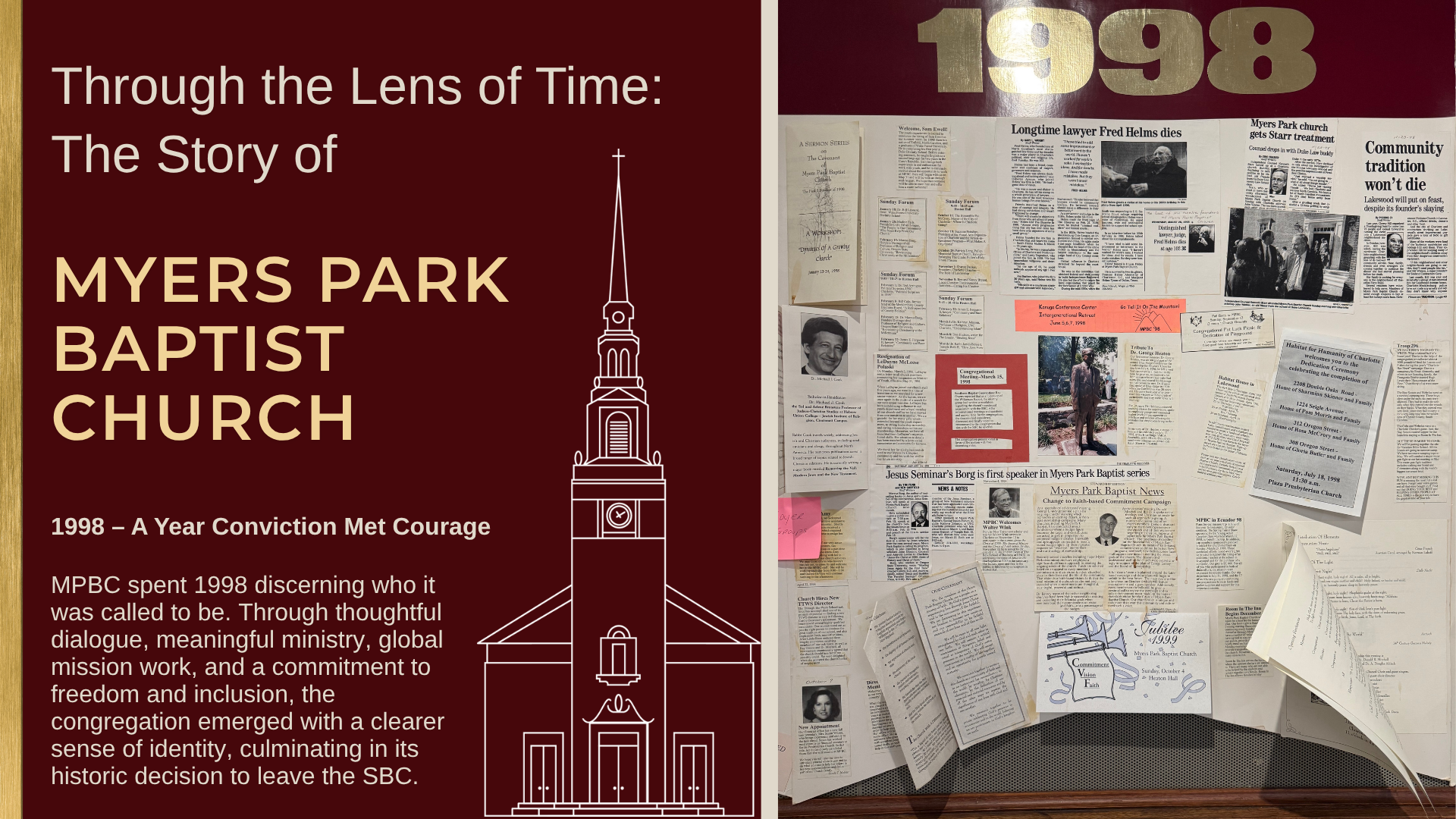
1998 - A Year Conviction Met Courage
What does a church do when long-held assumptions no longer fit its understanding of faith, conscience, and community? In 1998, Myers Park Baptist Church faced that question with unusual honesty and courage. As conversations about Baptist identity, theological freedom, and congregational autonomy moved from discussion to decision, the church found itself defining not simply what it believed, but who it wanted to be. Alongside moments of transition, remembrance, mission, and new beginnings, 1998 became a year in which Myers Park Baptist embraced its distinctive voice and demonstrated that faithful discipleship can make room for both deep conviction and thoughtful inquiry.
A Defining Decision About Baptist Identity
Following the Wilkerson Report, Ray Owens reported that the church’s identity group had developed a resolution concerning Myers Park Baptist’s relationship with the Southern Baptist Convention (SBC). After opportunities for information, questions, and congregational discussion, the deacons recommended ending the church’s ties with the SBC. The congregation present approved the recommendation with only two dissenting votes, marking one of the most significant moments in the church’s modern history. The decision represented more than a denominational realignment; it was a public declaration of the congregation’s commitment to local church autonomy, freedom of conscience, and a distinctly progressive Baptist witness.
A Church Open to Questions About Jesus
Myers Park Baptist continued to create space for serious theological exploration through its “Jesus the Christ at 2000: Jesus of History and Christ of Faith” series. Walter Wink was invited to speak alongside Dr. Claude C. Lilly on Jesus and the marketplace, while Marcus Borg was scheduled to lecture, teach at the Sunday Issues Forum, and preach. The series also anticipated visits from John Dominic Crossan and Amy-Jill Levine. Kathryn Johnson was scheduled to address Islam, and Rabbi James Bennett of Temple Beth El was invited to discuss Jewish perspectives on Jesus. Together, these offerings reflected a congregation willing to welcome scholarship, interfaith conversation, and honest questions rather than fear intellectual inquiry.
Tribute to Dr. George Heaton
Myers Park Baptist honored the life and legacy of Dr. George Heaton, the church’s first senior minister and a longtime presence at the Blue Ridge Conference on Leadership. For 56 years, Heaton shared wisdom, faith, and practical leadership with generations of people, training supervisors, encouraging employees, and counseling leaders. His influence extended far beyond the church's walls, and plans were announced to dedicate a statue in his honor at the Blue Ridge YMCA Assembly on July 17, 1998. His life remained a model of servant leadership and faithful ministry.
LeDayne McLeese Polaski Begins a New Chapter
After five years of ministry at Myers Park Baptist, LeDayne McLeese Polaski announced her resignation as Minister of Youth, effective May 31. During another season of transition in the life of the church, she had provided stability, leadership in worship, organizational strength, and compassionate care throughout the congregation. Her commitment to justice, fairness, and social responsibility was widely appreciated. Joe Aldrich expressed gratitude for the many gifts she brought to the church while extending best wishes for her future ministry.
Welcoming Sam Ewell
The youth ministry welcomed Sam Ewell as its 1998 summer intern. A native of Enfield, North Carolina, and a graduate of Wake Forest University, Sam was completing his first year at Duke Divinity School after teaching English as a second language in the Czech Republic. His enthusiasm, international perspective, and passion for ministry brought fresh energy to the youth program during a year of transition.
Remembering Fred Helms
The congregation also mourned the death of Fred Helms, a founding member of Myers Park Baptist Church and a respected Charlotte attorney, who died at age 102. In an account written by Gary L. Wright, Helms was remembered as a man of courage, integrity, determination, and strong convictions who was nevertheless willing to embrace change. Osborne Ayscue, Larry Dagenhart, and Jon Buchan reflected on his vision, leadership, and belief that lawyers should use their talents in service to their communities. Helms played a significant role in advancing civic projects such as Independence Boulevard and helping establish organizations that paved the way for what became United Way. During the struggle over school desegregation, he urged civic and professional leaders to support public education. Throughout his life, Helms sought to leave the world better than he found it. He was survived by his daughters, Frances Helms Abernethy and Margaret Helms Tyson, and his legacy continued to shape both the church and the Charlotte community.
Welcoming Amy Jones
Staff transitions continued when Linda Burris, recently welcomed as executive assistant to the interim senior minister, resigned following a medical diagnosis that required surgery. Amy Jones, already known and trusted within the congregation through her volunteer service, stepped into the position on a part-time basis. Together with Garrett DeVane, who continued serving in the afternoons, she helped provide continuity, stability, and familiar care during a significant season of change.
New Leadership for the Through-the-Week School
Following Carole Outwater’s retirement, the Through-the-Week School task force conducted an extensive search for a new director. Linda Ibsen emerged as the unanimous choice after interviews with the task force, Ray Owens, and Dr. Mitchell. Her selection was viewed not only as a continuation of the school's strong tradition but also as an opportunity to bring fresh ideas and renewed vision to this important ministry with children and families.
Welcoming Susan Wilson
The church’s financial office welcomed Susan Wilson as its new full-time secretary. Bringing valuable experience from Sardis Presbyterian Church, Susan arrived well prepared for her new responsibilities. Her addition represented yet another example of the church strengthening its ministries through thoughtful leadership and service.
Stewardship Rooted in Faith and Vision
George Linney introduced a new approach to stewardship that moved beyond budget-driven fundraising toward faith-centered commitment. Rather than asking members to contribute simply to meet institutional goals, the campaign encouraged individuals to reflect on their vision for the church’s future and its impact on the wider community. Linney, Donald Mitchell, and Bill Dols articulated the theological foundation for this approach, while church leaders and members shared their hopes for Myers Park Baptist. Ray Owens emphasized the importance of preserving the church’s unique voice and witness, reinforcing themes that would define much of 1998.
MPBC in Ecuador '98
The congregation's ministry extended beyond Charlotte through plans for a mission trip to Guayaquil, Ecuador. Members organized fundraising events, including a Spring Talent Show and a pancake breakfast, raising more than $1,200 toward a larger goal of supporting educational ministries in Ecuador. Seventeen participants prepared to travel on July 31, gathering resources and supplies to strengthen their partnership with the community there. The effort reflected a commitment to living out faith through global engagement and service.
Room in the Inn: Hospitality for People Experiencing Homelessness
Myers Park Baptist once again committed itself to Room in the Inn, a ministry providing overnight hospitality for people experiencing homelessness. Beginning in December and continuing through the winter months, volunteers prepared meals, offered transportation, and opened church facilities to guests, including families who could not be accommodated in traditional shelters. The ministry provided a tangible expression of Christian hospitality and invited more members to engage directly in compassionate service.
What Myers Park Baptist Celebrates
Perhaps the clearest expression of the church’s evolving identity came in a statement outlining the values Myers Park Baptist celebrated. The declaration affirmed religious liberty, the priesthood of all believers, separation of church and state, congregational autonomy, intellectual inquiry, tolerance, and respect for human dignity. It also affirmed the equal calling of women and men to ministry and embraced diversity within the life of the church.
Those values were reflected in the testimony of an individual who had spent nearly three decades away from church because traditional Baptist congregations had not felt like home. At Myers Park Baptist, that person discovered a community where seekers were welcomed, questions were valued, and faith was strengthened rather than threatened by thoughtful inquiry. It was a powerful reminder of the kind of church Myers Park Baptist was striving to become.
Looking back, 1998 stands as a watershed year in the story of Myers Park Baptist Church. Through a defining decision about denominational affiliation, an embrace of theological exploration, investments in mission and hospitality, and a clear articulation of its core values, the congregation moved beyond simply reacting to change and began intentionally shaping its future. The church honored those who had built its foundation, welcomed new leaders for the journey ahead, and affirmed a vision of Baptist faith rooted in freedom, compassion, inclusion, and thoughtful discipleship. By year’s end, Myers Park Baptist had done more than define its identity. It had claimed it.