
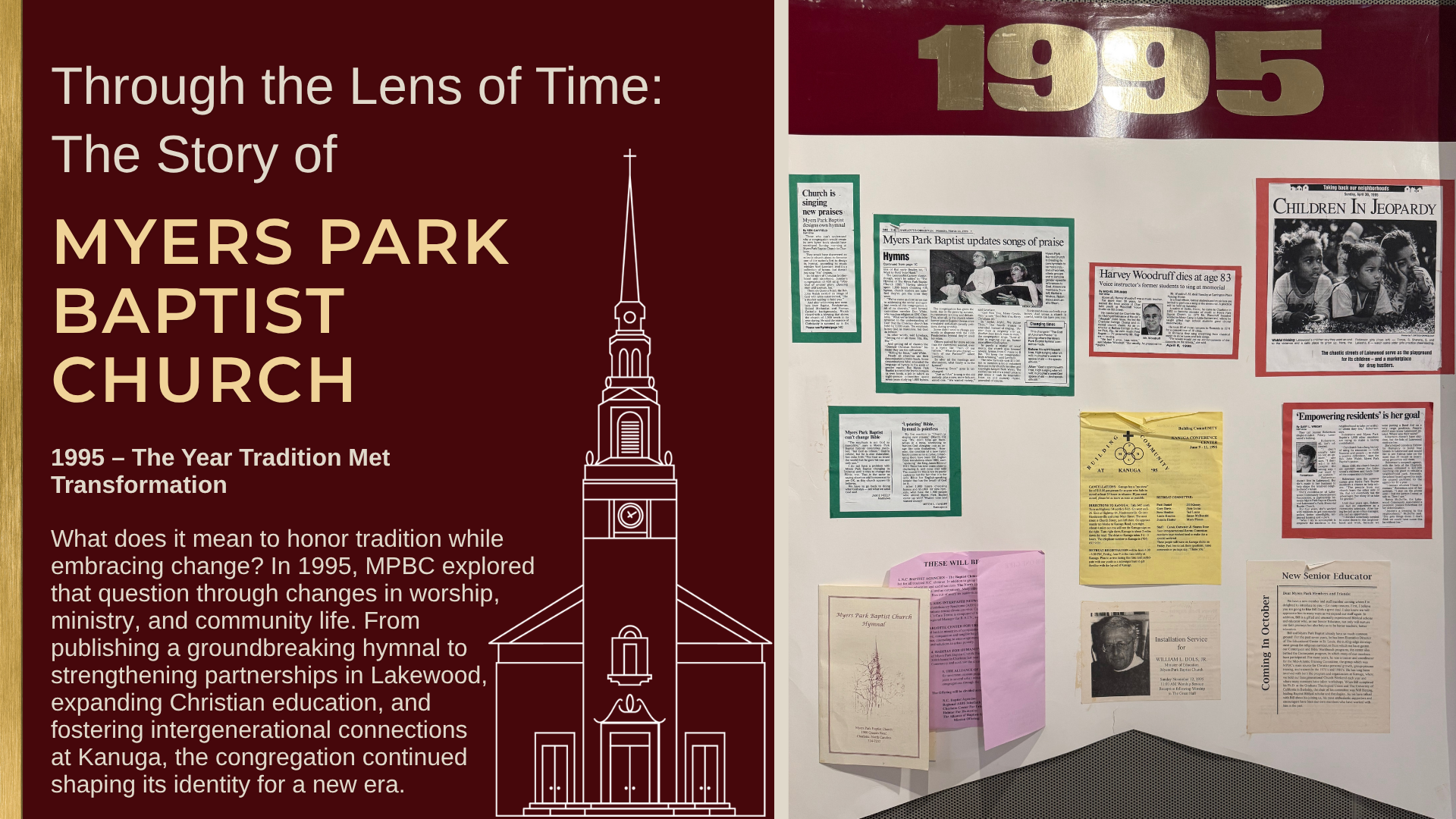
1995 - The Year Tradition Met Transformation
In 1995, Myers Park Baptist Church found itself balancing tradition and change in ways both visible and subtle. How could a congregation remain rooted in its heritage while responding faithfully to a changing world? That question surfaced in worship, education, community ministry, and fellowship. The publication of a new hymnal sparked public discussion and reflected deeper conversations about language, theology, and identity. At the same time, the church strengthened its partnership with the Lakewood community, invested in Christian formation, and nurtured relationships across generations during its annual retreat at Kanuga. Together, these stories reveal a congregation seeking not simply to preserve its heritage, but to discern how that heritage could guide its future.
A Hymnal for a Changing Church
One of the year’s most significant undertakings was the publication of The Hymnal of The Myers Park Baptist Church. The project had begun seven years earlier, when Dr. Eugene Owens appointed a Hymnal Task Force following recommendations from the Music Committee and Board of Worship to review the congregation’s 1933 hymnbook. The task force included Noël Lovelace, Ted Lucas, Barbara Mishoe (chair), Fran Morrison, Dan White, Elise Williams, Gary Rogers (1988–1989), and Bertha Wagster (1988–1992).
After seven years of study, the review of nearly 1,000 hymns, and more than 1,800 hours of work, the committee selected 408 hymns intended to reflect the congregation's theological breadth and diversity. The project cost $51,000, with significant volunteer work from church members, including copyright lawyer Burk Wyatt. The result was more than a new collection of hymns; it was an intentional theological statement about who God is and who the church is becoming.
Music minister Noël Lovelace and hymnal committee member Dan White described the goal as being attentive to the Christian tradition while resisting the assumption that God must be understood through exclusively masculine language. As White explained, the emphasis was not “God as masculine,” but “God as infinite.” That conviction shaped concrete changes. “God Rest You, Merry Gentlemen” became “God Rest You, Merry Christians All.” In “Joyful, Joyful, We Adore Thee,” language about “Father” and “Brother” was replaced with language about divine love and human love. “The God of Abraham Praise” changed “His spirit floweth free” to “God's spirit floweth free.”
The committee also removed or reconsidered hymns whose imagery they believed glorified militarism. “Onward Christian Soldiers,” for example, was rejected because of its association with violence in the name of faith. As Dan White put it, the concern was essentially about “killing for Jesus.” Not every tradition was discarded. “Amazing Grace” remained unchanged, while “Just as I Am” retained its traditional melody and gained a new, more folk-oriented setting. Some hymns were simply lowered in key so that congregants could sing them more comfortably.
The process was not without controversy. Letters to the Charlotte Observer criticized the congregation for altering traditional hymn language and questioned whether changing the hymnal represented a broader departure from traditional Christian understandings of Scripture.
Remembering Harvey Woodruff
The congregation also remembered the life and musical legacy of Harvey Woodruff, who died at age 83. Woodruff came to Charlotte in 1952 as minister of music at Myers Park Baptist Church and spent more than three decades teaching young singers through his Woodruff Voice Studio. He conducted performances of Handel’s Messiah, led the Charlotte College Chorus, directed church choirs, and taught at Rollins College in Florida, where one of his students was Fred Rogers, better known to generations of children as Mr. Rogers. In 1970, Woodruff founded Wildacres Music Camp in Little Switzerland, North Carolina, where gifted high school students studied and performed major choral works. In 1974, he took approximately 90 campers to Romania for a ten-city concert tour, where they performed classical music, folk songs, and show tunes. His memorial invited former students and musicians to participate by singing- a fitting tribute to someone whose vocation was in helping other people find their voices.
Empowering Lakewood
The church’s commitment to justice was visible through its continuing work in Charlotte’s Lakewood neighborhood. Jeanne Robertson, described by residents as Lakewood’s “bulldog,” coordinated the Lakewood Community Development Corporation, a partnership between Myers Park Baptist Church and Faith Memorial Baptist Church. For four years, Robertson worked alongside residents on issues including community policing, streetlights, housing, and parks. Her goal was explicit: to empower residents to take ownership of the neighborhood where they lived.
That distinction matters. The work was not simply about Myers Park Baptist “helping” Lakewood. Robertson emphasized listening to residents in their own voice and power. Myers Park Baptist contributed both financial and human resources. Since 1986, the church had sponsored summer camps for Lakewood children and funded most of the Community Development Corporation’s budget. Robertson also helped bring Habitat for Humanity into the neighborhood, contributing to the construction of four homes and advocating for the redevelopment of more than 30 vacant or boarded-up properties. Through a partnership involving Myers Park Baptist Church, Faith Memorial Baptist Church, Habitat for Humanity, and Lakewood residents, housing improvements became a visible sign of the community's renewal. The city's 200th Habitat house, completed in 1994, stood as evidence of what such collaboration could accomplish.
Pastor John Walsh articulated the congregation’s motivation clearly: Myers Park Baptist had “a long history of using its resources—both financial and people—to make a positive difference.” Robertson challenged Myers Park members to encounter realities beyond their own social and economic experience. The summer camps, she observed, allowed church members to learn that “not everybody has the advantages that many of us take for granted.” Nancy McDuffie, president of the Lakewood Community Association, called Robertson “a blessing to this neighborhood,” crediting her determination with helping the community come as far as it had.
A New Senior Educator
As the church invested in ministries beyond its walls, it also strengthened opportunities for learning and spiritual growth within the congregation. The church expanded its educational ministry by welcoming Bill Dols as Senior Educator. Dols came to Myers Park Baptist with extensive experience in biblical education and faith formation. For seven years, he had served as executive director of The Educational Center in St. Louis, the curriculum development organization behind programs such as Centerquest and Bible Workbench, both of which Myers Park members had used. The center also developed Centerpoint, another program in which members participated. Dols had previously served as a trainer and coordinator with the Mid-Atlantic Training Committee, which had been a major source of Christian personal-growth and group-process training for Myers Park Baptist during the 1970s and 1980s. He was also involved with Kanuga, the North Carolina conference center where the congregation held its annual Intergenerational Church Weekend.
Building Community Across Generations
The congregation’s 1995 Intergenerational Retreat at Kanuga emphasized community-building across age groups. The retreat committee included Patti Daniel, Gary Davis, Sara Hendon, Linda Hendon, Juanita Hunter, Jill Kinney, Jane Lucas, Ted Lucas, Susan McDonald, and Mary Pinson, with staff support from Carole Outwater and Sharon Doar.
Their work reflected an understanding of church life as something built through relationships—not merely programs. An intergenerational community creates opportunities for children, youth, adults, and older adults to learn from one another and recognize that everyone has a place in the shared life of the church.
Looking back, 1995 was a year shaped by intentional reflection and faithful action. Whether through the publication of a groundbreaking hymnal, the ongoing partnership with Lakewood residents, the arrival of new educational leadership, or opportunities that brought generations together, Myers Park Baptist Church demonstrated a willingness to engage change thoughtfully rather than fear it. The year's events reflected a congregation confident enough to ask difficult questions, committed enough to serve beyond its own walls, and hopeful enough to embrace new possibilities. In many ways, 1995 was not defined by dramatic transformation, but by the steady work of shaping a church identity that would continue to influence Myers Park Baptist for years to come.