
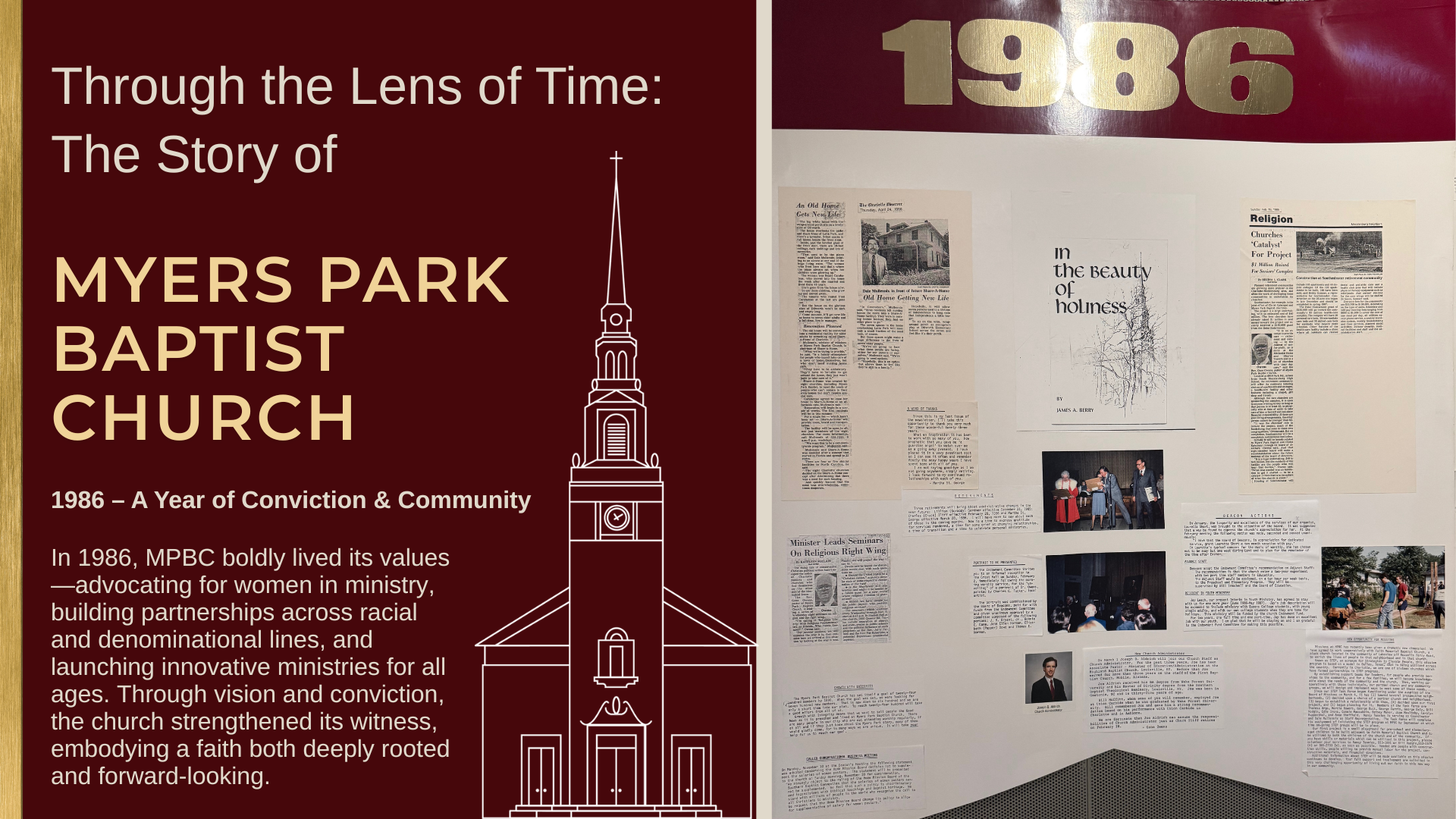
1986 - A year of Conviction and Community
In 1986, Myers Park Baptist Church lived into its identity with clarity and courage—choosing conviction over comfort and community over convention. Whether standing for women in ministry, building partnerships across racial and denominational lines, or investing in ministries that honored dignity at every stage of life, the church demonstrated a deep commitment to living out its faith in tangible, forward-thinking ways. This was a year not of quiet progress, but of purposeful action shaped by principle, vision, and a widening sense of responsibility to both congregation and community.
Standing for Women in Ministry
Long before many Baptist churches publicly embraced gender equality in ministry, Myers Park Baptist Church took a clear, principled, and public stand on the issue. Following a decision by the Southern Baptist Convention's Home Mission Board not to supplement the salaries of women pastors, the church’s Board of Deacons formally objected. The deacons adopted a statement opposing the policy, which was presented to the congregation for consideration.
The statement denounced the ruling as discriminatory and inconsistent with both biblical teaching and the historic values of the Baptist tradition. It affirmed “the call to all Christians to ministry,” regardless of gender, and urged the Home Mission Board to reconsider its position. In doing so, the church not only challenged denominational policy but also gave visible expression to its growing and enduring commitment to equality, inclusion, and shared leadership.
A Vision Becomes Southminster
Myers Park Baptist Church played a vital role in the creation of Southminster, a retirement community developed in partnership with Christ Episcopal Church. Led in part by Pastor Rev. Gene Owens, the project represented a major investment in senior care. Located on Park Road, Southminster was designed to include apartments, cottages, health-care facilities, a chapel, library, gift shop, and comprehensive medical services.
Together, the churches raised significant seed money for the project and secured support from The Duke Endowment, including a $150,000 grant. Owens described the church's role as that of a catalyst—helping launch a ministry that would ultimately become an independent, nonprofit institution serving the wider community. Among those involved in its development was Bobby Sumner, who represented Southminster during this formative period.
Building Partnerships Across Racial Lines
One of the most significant mission initiatives of the period was the church's participation in STEP (Strategies to Elevate People). Through STEP, Myers Park Baptist partnered with Faith Memorial Baptist Church, a predominantly Black congregation in the Lakeview community near Rozzelles Ferry Road. The goal was not charity from a distance but relationship, mutual learning, and collaborative community development.
Early plans included constructing a playground for neighborhood children and developing support networks for community leaders and families. The STEP partnership embodied Myers Park Baptist's commitment to racial partnership, neighborhood engagement, and putting faith into action beyond church walls.
Members of the STEP Task Force included: Theresa Argo, Marcia Bowers, George Buck, George Currin, George Daly, Bill Hodgin, Edie Irons, Connie Maccubbin, Betsey Maker, Joan Maultsby, Carolyn Ruppenthal, and Anne Sheffield. Leadership was provided by Nancy Tennies, Coordinator, and Dale Mullennix, Staff Representative.
Aging with Dignity: Creating New Options for Older Adults
In 1986, Myers Park Baptist Church helped launch innovative ministries for older adults, reflecting a commitment to care across generations. One such ministry was Share-A-Home of Charlotte, chaired by Dale Mullennix, then Minister of Missions. The program transformed the former home of Bessie Carabateas in Dilworth into a residential community for seven older adults and a live-in manager.
Supported by eight Charlotte churches, Share-A-Home provided a family-style living arrangement for seniors who could no longer maintain a home independently but did not require nursing-home care. The facility was open to all, not just members of the supporting churches. Mullennix emphasized that the goal was to create "a family atmosphere" providing an alternative that preserved independence, dignity, and community connection. This initiative reflected Myers Park Baptist's longstanding commitment to responding creatively to unmet social needs.
Defending Religious Liberty in a Polarized Time
As the Religious Right gained political influence during the 1980s, Myers Park Baptist Church provided space for thoughtful dialogue and theological reflection. Rev. Gene Owens led a Wednesday evening seminar series titled "Religious Liberty: With Religious Fundamentalists as Friends, Who Needs Enemies?"
The discussions explored the separation of church and state, prayer in public schools and religious freedom. Participants were invited to wrestle with enduring questions about democracy, faith, pluralism, and the role of religion in public life—issues that remain relevant today.
Growing with Integrity
During this period, Myers Park Baptist Church set an ambitious goal of reaching 2,400 members by 1990. When the goal was set, that meant they were looking for 700 new members. This initiative, called “Growth with Integrity,” emphasized that numerical growth should arise not from marketing strategies alone, but from a faithful expression of the church’s unique identity and witness.
By 1986, the congregation had made significant progress, needing only 600 more members to reach its goal. The campaign encouraged members to actively invite others into a community grounded in thoughtful faith, Baptist freedom, and authentic relationships. In this vision, growth was understood not simply as expansion, but as an extension of the church’s core values and shared commitment to meaningful community.
Supporting Music, Education, and Young People
The Board of Deacons recognized the faithful ministry of organist Lauretta Short, granting her a two-month paid vacation in appreciation for her years of dedicated service. The church also approved a two-year experiment with adjunct education staff to strengthen preschool and elementary ministries under the supervision of Bill Treadwell and the Board of Education.
In youth ministry, support and funding by the church Endowment Fund allowed Jay Leach, acting Interim in Youth Ministry, to remain for an additional year. His role was expanded to include ministry with Queens College students, young single adults, and Myers Park Baptist Church’s own college students while they were home for the holidays.
In the Beauty of Holiness
James A. Berry, Minister of Music, wrote In the Beauty of Holiness to preserve for future generations the meaning and significance of worship at Myers Park Baptist Church. In this work, he explores each element of worship, Christian symbols, and the church’s architecture, offering insight into the rituals of worship, liturgical tradition, the Christian year, rites of passage, and the lectionary. He also explains the structure and meaning of the worship service, including the sacraments of Baptism and Holy Communion, and provides thoughtful interpretation of the sanctuary’s spaces and architectural features.
Jim expressed deep gratitude to those who contributed to the book’s creation: Tillie Tice for encouraging him to undertake the project; Dr. R. Eugene Owens for critical analysis and guidance; Fran Morrison for typing the manuscript; Esther Creasman and Jennifer Mullennix for critical reading and editorial suggestions; Carey Dowd for guidance on form; Neta and Bob Tobias for final correction and printing; and his wife, Ann Berry, for her continuous encouragement, insightful suggestions, and careful proofreading.
Portrait for Dr. Gene Owens
The church celebrated the ministry of Rev. Gene Owens by commissioning a portrait by local artist Charles C. Tucker. The project was supported by the Endowment Committee and approved by a committee consisting of J. R. Bryant, Jr., Bonnie E. Cone, Jane Ellen Norman, Elizabeth (Pepper) Dowd, and Thomas E. Norman. The portrait was unveiled at a church reception in The Great Hall (now Heaton Hall) following the morning worship service.
Welcoming Joseph D. Aldrich
The congregation also welcomed Joseph D. Aldrich as Church Administrator. He came to Myers Park Baptist from Highland Baptist Church in Louisville, Kentucky, where he served as Associate Pastor and Minister of Education/Administration and had previously served at First Baptist Church in Mobile, Alabama.
A graduate of Wake Forest University and Southern Baptist Theological Seminary, Aldrich succeeded Chuck Iliff upon his retirement. Rev. Gene Owens shared gratitude to former church member Bill Moffitt for his strong recommendation, based on Aldrich's earlier work with Union Carbide.
Thank You, Martha St. George
After twenty-three years of service, Martha St. George announced her retirement and expressed gratitude to the congregation in her final issue of the church newsletter. In her heartfelt farewell, she thanked members for their friendship and support and spoke warmly of the guardian angel gift she received from the church. Rather than saying goodbye, she looked ahead to continuing relationships with the people she had served for more than two decades.
Taken together, the events of 1986 reveal a congregation deeply attuned to both its convictions and its calling. Myers Park Baptist Church was not content to simply preserve tradition—it sought to interpret it faithfully for a changing world. From advocating for women in ministry to fostering racial partnerships, from supporting innovative care for older adults to preserving the meaning of worship for future generations, the church’s witness was both thoughtful and bold. In every initiative, there is a throughline of integrity—an enduring commitment to align belief with action, and to embody a faith that is as responsive as it is rooted.