
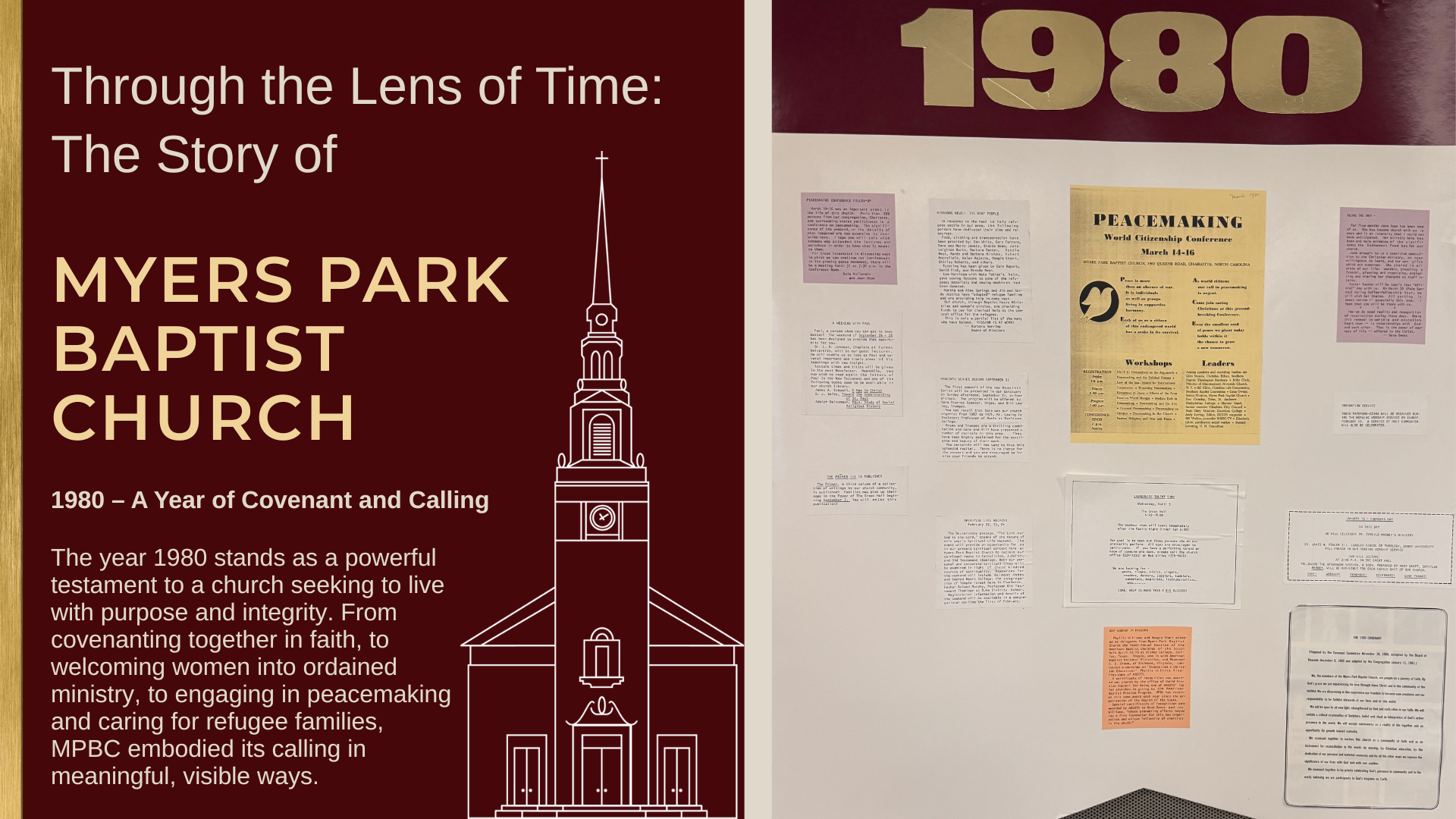
1980 - A Year of Covenant and Calling
What does it mean to be a church committed not only to faith, but to justice, reconciliation, and growth? In 1980, Myers Park Baptist Church answered that question with intention and vision. Through worship, learning, service, and courageous leadership, the congregation embraced a shared calling—one that would shape both its identity and its witness for years to come.
Covenanting for Justice, Growth, and Reconciliation
The 1980 Covenant of Myers Park Baptist Church marked a defining moment in the life of the congregation. Prepared by the Covenant Committee on November 30 and accepted by the Board of Deacons on December 8, it was ultimately adopted by the congregation on January 11, 1981. Through this covenant, the church committed itself to spiritual growth, critical engagement with Scripture and tradition, and a shared calling to reconciliation, stewardship, and faithful community in the world.
Milestones in Our Life Together
The Founders’ Day celebration honored the enduring legacy of Dr. Carlyle Marney, with Dr. James W. Fowler, III serving as preacher and lecturer. Each family received a commemorative publication of the book, "Marney" by Mary Kratt, preserving and sharing Dr. Marney’s impact.
In February, the church celebrated the ordination of Robin Paterson-Coira, joyfully welcoming her into ministry and marking an important step in the congregation’s evolving leadership.
Peacemaking as a Way of Life
More than 200 participants from Myers Park Baptist Church, Charlotte, and surrounding states gathered for a powerful Peacemaking World Citizenship Conference. The event centered on the call to live as global citizens committed to justice and peace.
Leaders included Glen Stassen (Christian Ethics, Southern Baptist Theological Seminary), Mike Clark (Minister of Disarmament, Riverside Church, NY), Bill Elder (Christian Life Commission, Southern Baptist Convention), Gene Owens (Senior Minister, MPBC), Ron Crossley (Dean, St. Andrews Presbyterian College), Harvey Gantt (former Charlotte City Council member), Rush Otey (Minister, Davidson College), Andy Loving (Editor, SEEDS magazine), Bill Walker (WSOC-TV journalist), Elizabeth Little (psychiatric social worker), and Samuel Levering (U.N. consultant).
A follow-up gathering in March, led by Dale Mullennix and Joan Hope, invited continued engagement in the growing peace movement, extending the conference’s impact beyond a single event.
Mission in Action: Welcoming the Stranger
The congregation lived out its commitment to hospitality and justice through its support of refugee “boat people” families. Volunteers—including Dan White, Gary Ferraro, Dave and Marty Jowett, Brenda Bean, Jane Leighton Burts, Barbara Senter, Dottie Best, Randy and Barbara Mishoe, Hubert Moorefield, Helen Majette, Veegie Short, Shirley Roberts, Gary Rogers, David Rish, Lee Harrison, Neta Tobias, Martha and Alex Springs, and Jim and Sandy Justice—offered food, transportation, tutoring, sewing lessons, and ongoing family care. Through Baptist Metro Ministries and the leadership of women’s circles, coordinated by Barbara Herring and the Board of Missions, the church embodied compassion in tangible, life-changing ways.
Regional Leadership & Recognition
Phyllis Williams and Veegie Short represented Myers Park Baptist Church at the American Baptist Churches of the South (ABCOTS) gathering, where Veegie Short and Rev. O. D. Brown also led a workshop on evangelism and Christian education.
The church was again honored as a Top Ten contributor to the American Baptist Mission Program—an award it had received each year since the organization of the Region of the South. Special certificates of recognition were presented to Gene Owens and Joe Williams for their foundational leadership and lasting contributions.
Worship, Arts, and Community Life
The Hyacinth Series began with a free concert featuring Sara Starnes Spencer (organ), who had served as organist at Myers Park Baptist Church from 1967 to 1971, and Bill Lawing (trumpet).
Community life flourished in creative and joyful ways. A churchwide talent show, coordinated by Bob Gilley and held after Family Night Dinner in the Great Hall (now Heaton Hall), invited participation from all ages. Whether poets, clowns, mimics, singers, dancers, jugglers, comedians, or musicians, members shared their gifts in a spirit of encouragement and celebration.
Deepening Faith Through Learning
A teaching weekend, “A Weekend with Paul,” featured Dr. L. D. Johnson of Furman University, inviting renewed engagement with the Apostle Paul. Suggested reading included works by James A. Stewart (A Man in Christ), D. J. Selby (Toward the Understanding of St. Paul), and Adolph Deissmann (Paul: A Study of Social and Religious History).
The Spiritual Life Weekend in February called participants to reconnect with their spiritual roots in Catholicism, Judaism, and Old Testament theology. Contributors from Belmont Abbey, Sacred Heart College, Temple Israel (Charlotte), and Father Roland Murphy of Duke Divinity School guided participants in examining both personal and corporate faith through these rich traditions.
Gratitude and Transition in Ministry
The church gave thanks for the meaningful ministry of Joan Hope, whose five months of service concluded at Easter. In a note to the congregation, Dr. Gene Owens wrote:
“Joan brought … a sensitive compulsion to the Christian ministry, an open willingness to learn, and her own gifts which are numerous. She shared in all areas of our life: worship, preaching a funeral, planning and organizing, evaluating and sharing her thoughts on staff interns. Her ministry here has been more evidence of the significance the Endowment Fund has for our church.”
He closed with a reflection that captured both the moment and the spirit of the congregation:
“How we do need reality and recognition of resurrection during these days. Share this renewal in worship and education. Start over—in relationships with God and each other. That is the power of newness of life—offered in the Christ.”
A Year That Shaped the Future
The year 1980 stands as a powerful testament to a church seeking to live with purpose and integrity. From covenanting together in faith, to welcoming women into ordained ministry, to engaging in peacemaking and caring for refugee families, Myers Park Baptist Church embodied its calling in meaningful, visible ways.
Through worship, learning, and community life, the congregation balanced gratitude with growth—stepping forward with hope into a future shaped by faith, justice, and renewal.