
1976 - A Year of Practiced Belonging
The story of Myers Park Baptist Church in 1976 is a story about formation—of faith, of identity, and of community. Throughout the year, the congregation returned again and again to a central question: how do we grow together? Through remembering their shared history, creating space for intergenerational connection, engaging music and the arts, and exploring faith through education and service, the church strengthened its sense of who it was and how God was at work among them.
Chosen Family and Intergenerational Joy
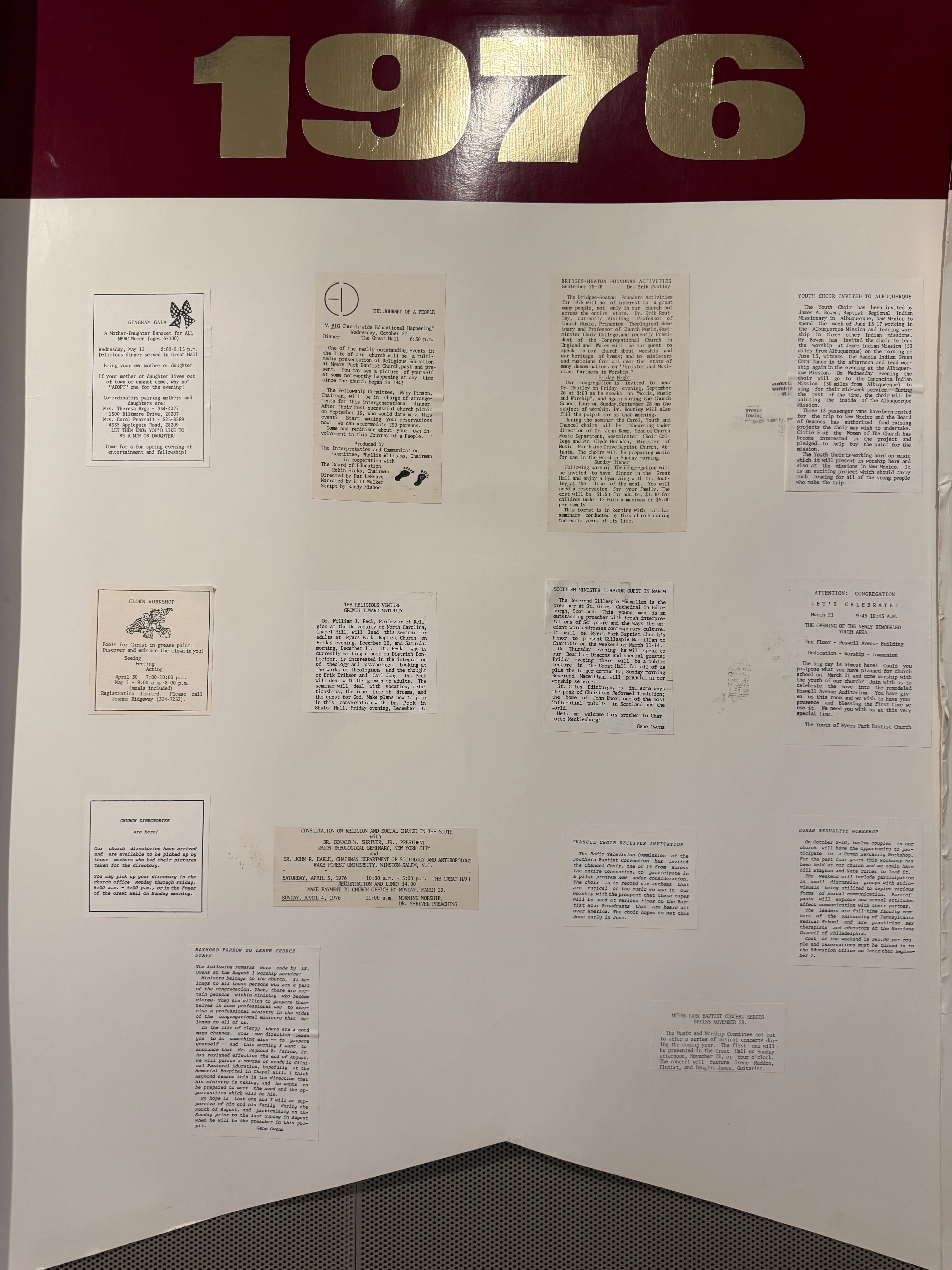
A strong sense of intergenerational community defined congregational life in 1976. Events such as the Gingham Gala invited women of all ages into joyful fellowship, even encouraging participants to “adopt” a mother or daughter for the evening. Coordinated by Mrs. Theresa Argo and Mrs. Carol Pearsall, the intentional pairings reflected an early expression of chosen family—creating space for relationship beyond biological ties.
Gatherings like these reveal a church deliberately cultivating belonging, ensuring that no one was overlooked and everyone was invited into shared joy.
The arrival of the church’s first pictorial directory that year echoed this same impulse—helping members recognize one another, learn names and faces across generations, and deepen the sense that this was a community where people truly knew and belonged to one another
Telling Our Story Together
The congregation leaned deeply into its own history as a source of connection and meaning. A multimedia, church‑wide educational event titled The Journey of a People invited members to reflect on their shared story since the church’s founding in 1943. Promotional materials promised that participants might even spot themselves “at some noteworthy happening any time since the church began in 1943!”
Produced by the Interpretation and Communication Committee under the leadership of Phyllis Williams, in cooperation with the Board of Education chaired by Robin Hicks, the event was directed by Pat LeNeave, narrated by Bill Walker, and scripted by Randy Mishoe. Through images, storytelling, and intergenerational participation, the church strengthened its communal memory and reaffirmed its shared identity.
Formed in Worship, Music, and the Arts
Worship in 1976 was richly shaped by music and the arts. The Bridges‑Heaton Founders Activities brought Dr. Erik Routley—visiting Professor of Church Music at Princeton Theological Seminary, Professor at Westminster Choir College, and President of the Congregational Church in England and Wales—to help the congregation explore the power of hymnody and worship.
On Friday evening, Dr. Routley spoke on “Words, Music, and Worship.” Over the course of the weekend, the Carol, Youth, and Chancel choirs rehearsed with Dr. John Kemp of Westminster Choir College and Mr. Clyde Herndon of Atlanta’s Northside Drive Baptist Church. On Sunday, choirs of all ages participated in worship, reinforcing the belief that music was not performance alone, but a vital form of spiritual formation and communal prayer. The weekend concluded with a congregational dinner in the Great Hall (now Heaton Hall), followed by a hymn sing led by Dr. Routley.
That same year, the Chancel Choir was invited to participate in a pilot program of the Radio‑Television Commission of the Southern Baptist Convention, recording six anthems representative of Myers Park Baptist’s worship life for The Baptist Hour broadcasts heard across the country.
In November, the Music and Worship Committee also announced a new concert series, beginning with a performance by flutist Irene Maddox and guitarist Douglas James.
Youth Leadership, Service, and a Wider World
The life of the church extended well beyond Charlotte through meaningful opportunities for youth engagement. The Youth Choir accepted an invitation from James A. Bowen, Baptist Regional Indian Missionary in Albuquerque, New Mexico, to spend a week in mid‑June painting the Albuquerque Mission and leading worship in three other Indian missions.
With support from the Board of Deacons, fundraising projects, and assistance from Circle 5 of the Women of the Church—who helped purchase paint—the trip combined worship leadership, hands‑on service, and cross‑cultural engagement. The experience reflects a growing awareness of global connection and faith lived out through action.
Creative Faith and Embodied Spirituality
The church also explored imaginative and embodied expressions of faith. A Clown Workshop titled “Fools for Christ in Grease Paint” invited participants to discover the clown within themselves, using creativity, movement, and play as pathways to spiritual insight. Such offerings signal a willingness to move beyond traditional forms, affirming that wisdom and faith can emerge through the arts as readily as through words.
Faith, Psychology, and Adult Growth
Adult education in 1976 embraced both theological depth and human experience. Seminars such as “The Religious Venture: Growth Toward Maturity,” led by Dr. William J. Peck of the University of North Carolina at Chapel Hill, explored vocation, relationships, dreams, and the inner life—from theological and psychological perspectives. Drawing on thinkers such as Erik Erikson and Carl Jung, and informed by Dr. Peck’s work on Dietrich Bonhoeffer, the program encouraged whole‑person spiritual growth.
That fall, a fifth offering of the popular Human Sexuality Workshop allowed twelve couples to engage in small‑group discussion using audio‑visual materials related to communication and relationships. These conversations reflected the church’s commitment to addressing real dimensions of life with thoughtfulness and care.
Religion, Society, and the Call to Change
The congregation also hosted a weekend Consultation on Religion and Social Change in the South, featuring Dr. Donald W. Shriver, Jr., President of Union Theological Seminary in New York City, and Dr. John R. Earle of Wake Forest University. These dialogues connected faith to broader social realities, inviting the church to consider its public witness in a changing world.
Global Voices and Ecumenical Vision
Myers Park Baptist welcomed voices from beyond its own tradition, including the Reverend Gillespie Macmillan of St. Giles’ Cathedral in Edinburgh, Scotland—one of the most influential pulpits in the Reformed tradition and the historic home of John Knox. His preaching brought fresh insight into the ways ancient faith speaks to contemporary culture, broadening theological imagination and global perspective.
Investing in Youth and the Future
The youth themselves invited the congregation to celebrate the dedication of a newly remodeled youth space, previously known as the Roswell Avenue Auditorium, with a special worship service that included communion. The dedication affirmed young people not just as participants, but as vital leaders in congregational life—an investment both in the future and in the present.
A Shared Ministry, A Continuing Journey
Finally, 1976 marked a season of transition with the departure of staff member Raymond Farrow to pursue Clinical Pastoral Education. Rather than framing this as loss, Dr. Gene Owens reminded the congregation that ministry belongs to the whole church. Clergy serve within that shared ministry, preparing themselves professionally to meet new needs and opportunities. Raymond’s transition was celebrated as part of a faithful journey of discernment, supported by the community that had shaped him.
Seen together, the story of 1976 is one of expansive faith—faith that welcomed the young and the old, honored creativity and scholarship, faced hard conversations honestly, and reached beyond itself to the wider world. Myers Park Baptist Church practiced radical hospitality not as a slogan, but as a way of life, trusting that when all are invited to belong, the church becomes more fully what it is called to be.