
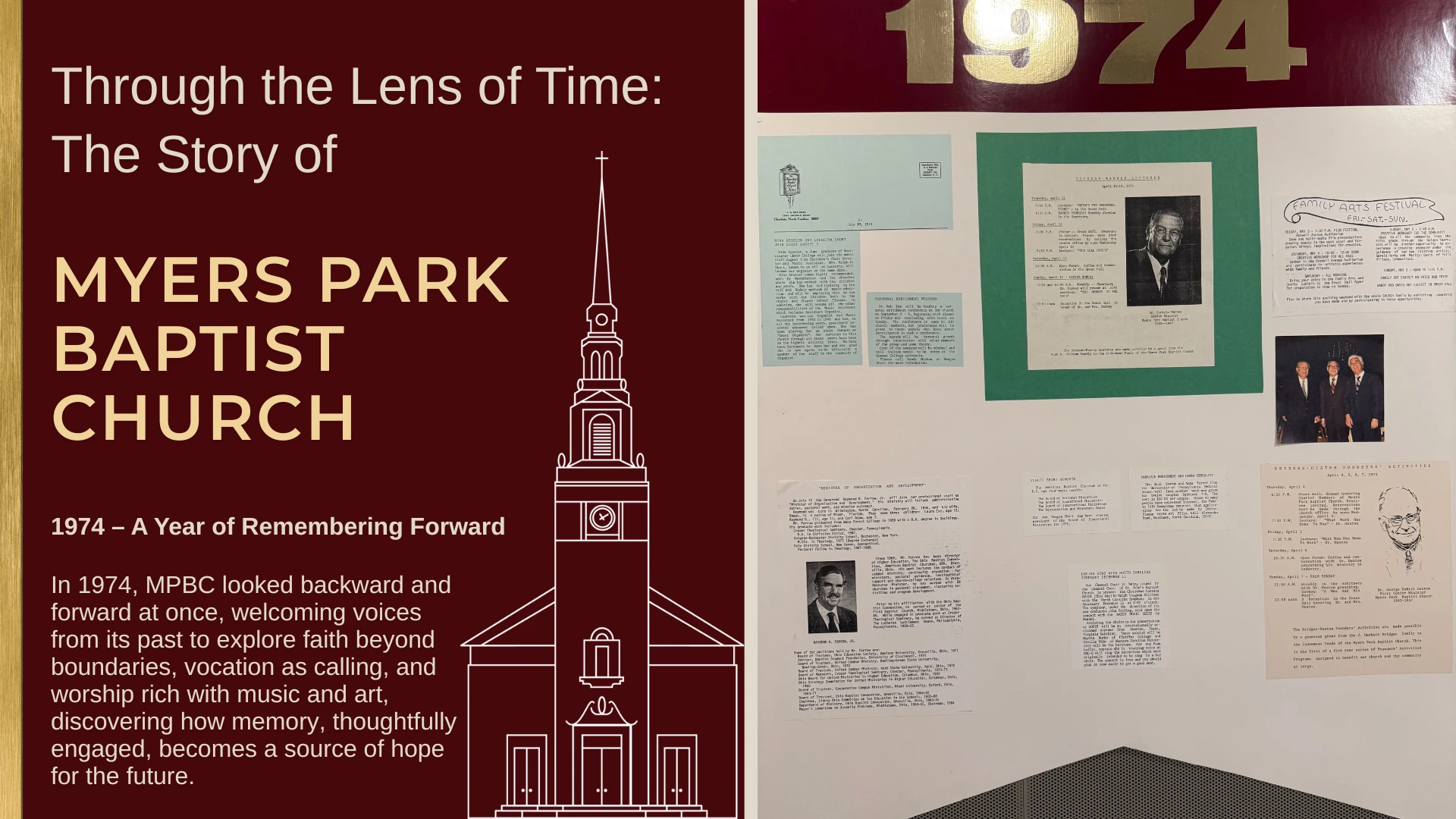
1974 - A Year of Remembering Forward
By 1974, Myers Park Baptist Church was learning how memory could become a source of hope. As beloved leaders from the church’s past returned to teach and preach, the congregation engaged its own story—not as something to preserve unchanged, but as a foundation for faithful imagination. Through lectures, worship, and creative expression, MPBC practiced the art of remembering forward, drawing on its history to ask deeper questions about unity, vocation, and what it meant to live the gospel with openness and courage.
Dickson–Marney Lectures: “Beyond the Denominations”
The year’s highlight was the Dickson–Marney Lecture Series featuring Dr. Marney, the second Senior Minister of Myers Park Baptist Church (1958–1967), who challenged the congregation to think and live beyond denominational boundaries. Lectures held in the Great Hall addressed themes such as “Beyond the Denominations” and “The Real Issues,” culminating on Easter Sunday with the sermon “The Memory Is the Hope.” A reception following worship honored Dr. and Mrs. Marney. Made possible by a grant from the Rush S. Dickson family, the lectures embodied Myers Park Baptist’s growing ecumenical spirit and theological depth.
Bridges–Heaton Founders’ Lectures: Faith and Work
Also marking 1974 was the inaugural Bridges–Heaton Founders’ Activities, held from Thursday evening through Palm Sunday afternoon. The series featured Dr. George Heaton, the first Senior Minister of Myers Park Baptist Church (1943–1957), who explored the relationship between faith and vocation. Lectures including “What Work Has Done to Man” and “What Man Has Done to Work” invited reflection on industry, identity, and Christian responsibility in the modern world—affirming that faith speaks meaningfully to public and professional life.
Dr. Heaton’s Sunday sermon, “A Man and His Work,” concluded the series and was followed by a reception in the Great Hall (now known as Heaton Hall) honoring Dr. and Mrs. Heaton. The Bridges–Heaton Founders’ Activities were made possible by a grant from the J. Herbert Bridges family and marked the first year of a five-year series of programs designed to benefit not only Myers Park Baptist Church, but the wider community as well.
New Staff Leadership
In 1974, the church strengthened its ministry team in several key areas.
Nina Kessler, a graduate of Westminster Choir College, joined the staff as Children’s Choir Director and Music Assistant. She introduced Orff and Kodály methods to children’s music formation, enriching both the choirs and Church School classes.
Mrs. Ralph H. Short—known to all as Lauretta—returned as Organist. Having previously served as Music Assistant from 1945 to 1948 and graciously assisted whenever called upon in the intervening years, she continued decades of faithful artistic leadership at the highest level.
Rev. Raymond B. Farrow, Jr. became Minister of Organization and Development, bringing extensive experience in campus ministry and higher education through the American Baptist Churches USA. His work included campus ministry leadership, continuing education for ministers, pastoral guidance, institutional support, and church-college relations. As an Area Resource Minister, he had worked with 56 churches in areas of pastoral placement, clustering activities, and program development. A graduate of Wake Forest College, he earned a B.A. in Sociology; a B.D. in Christian Ethics from Crozer Theological Seminary; an M.Div. in Theology from Colgate-Rochester Divinity School; and served as a Pastoral Fellow in Theology at Yale Divinity School. His responsibilities at MPBC included administrative leadership, mission outreach, and pastoral care.
Additionally, Veegie Short was elected president of the Board of Educational Ministries of the American Baptist Churches USA for 1975—an affirmation of her national leadership in Christian education.
Worship & the Arts Flourish
Worship and music continued to flourish in 1974. The Chancel Choir joined with St. John’s Baptist Church and the North Carolina Symphony to present Hodie (This Day) by Ralph Vaughan Williams in the MPBC Sanctuary. The program opened with Handel’s Water Music Suite and featured distinguished soloists, including MPBC member Fran Loftin, soprano. Loftin, who was studying voice at UNC–Greensboro, sang narrations originally intended to be performed by a boys’ choir. The concert reflected the congregation’s enduring commitment to excellence in sacred music.
Spiritual Growth & Family Life
The church also offered meaningful opportunities for personal and relational growth through Personal Enrichment weekends. These included Marriage Enrichment and Human Sexuality workshops led by Drs. Bill Stanton and Nate Turner of the University of Pennsylvania Medical School, as well as Maundy Thursday worship experiences. Together, these offerings demonstrated a congregation unafraid to engage both inner growth and relational honesty—reflecting a progressive Baptist commitment to holistic formation of mind, body, and spirit.
Family Arts Festival
Creativity found expression through a Family Arts Festival weekend that included a film festival featuring multi-media presentations celebrating beauty found in the most usual and often forgotten places. Creative workshops for all ages—open to both the congregation and the community—offered hands-on opportunities for artistic expression and guidance from visiting artists. The weekend culminated in an art exhibit, allowing all to enjoy the work that had been created.
Honoring Our Roots
A dinner honoring charter members reminded the congregation of its foundations, grounding the year’s forward-looking conversations in gratitude and memory. Even as Myers Park Baptist continued to explore new expressions of ecumenism, vocation, music, and human flourishing, it paused to celebrate those who had shaped its beginnings.
By year’s end, 1974 revealed a congregation deeply attentive to where it had come from and equally committed to where it was going. Through landmark lecture series, enriched worship and music, expanded staff leadership, honest engagement with personal and family life, and creative expressions shared with the wider community, Myers Park Baptist embodied a faith that was intellectually serious, artistically rich, and socially engaged. Honoring its past while pressing into new conversations, the church continued shaping an identity grounded in memory yet animated by hope—a community learning to live its calling beyond boundaries.